
Parliament's Final Legislative Push: A Year of Reform in an Uncertain World


As Parliament rises for its summer recess, Westminster closes the latest chapter of one of the most ambitious legislative programmes in recent years. Since the Cabinet reshuffle in September 2025, MPs and peers have overseen a series of reforms that have reshaped employment law, housing, planning, policing, constitutional reform and Britain's long-term economic strategy. While political attention is increasingly turning towards the prospect of a new Prime Minister and Cabinet, the legislative record left behind offers an indication of the direction the UK is taking in an increasingly volatile world.
This parliamentary session has unfolded against an exceptionally challenging international backdrop. Russia's continued invasion of Ukraine has fundamentally altered Europe's security priorities, conflict in the Middle East has disrupted global trade routes, while growing strategic competition between the United States and China has reinforced the importance of economic resilience, energy security and defence capability. Combined with slower domestic growth, high public borrowing, persistent pressures on the NHS and ongoing concerns over housing affordability, Parliament's agenda has reflected a government attempting to balance long-term structural reform with immediate economic realities.
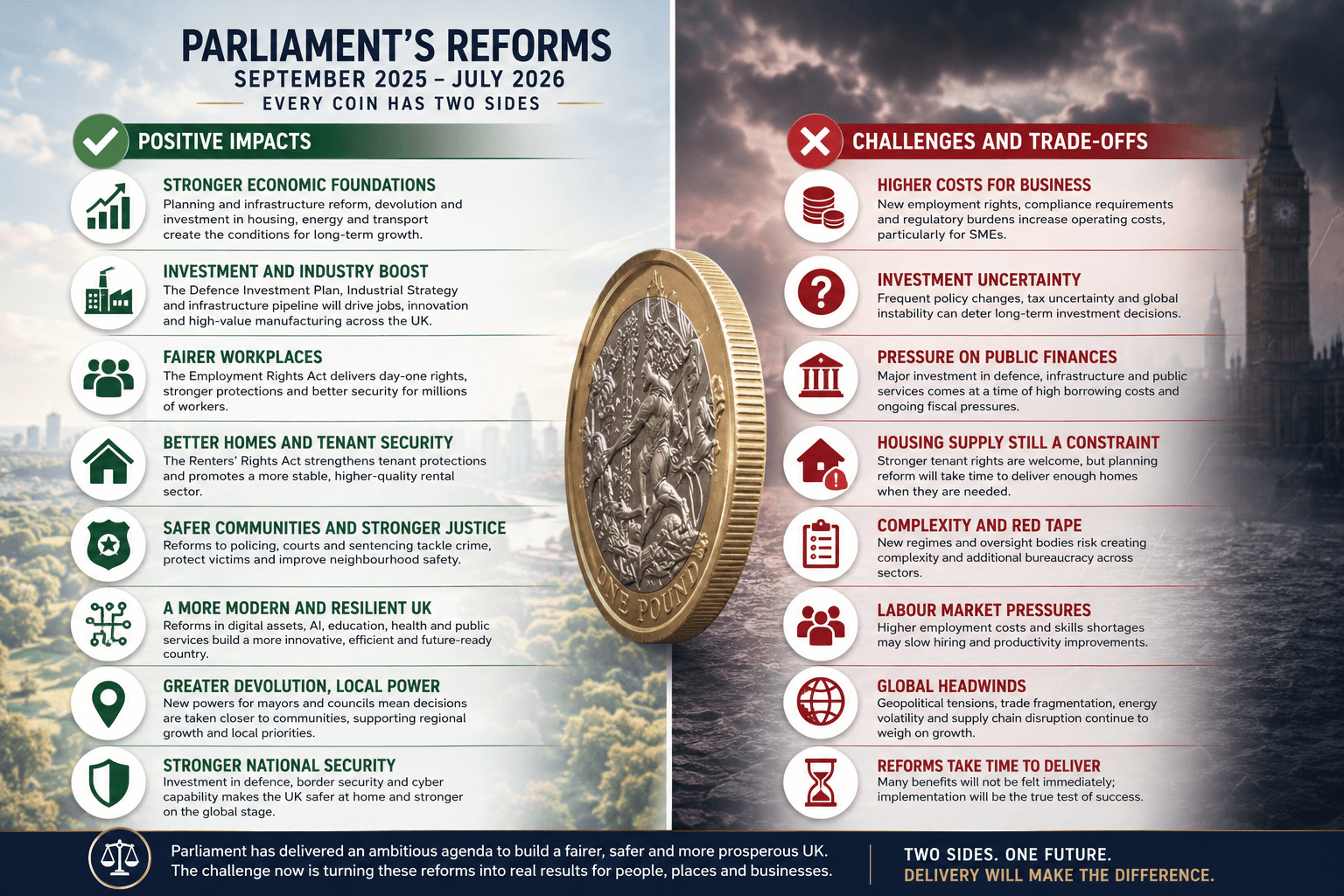
Perhaps the most significant development has been the renewed emphasis on economic growth. Planning and infrastructure reforms have sought to remove long-standing barriers to investment by accelerating planning decisions, streamlining major infrastructure projects and supporting ambitious housing targets. For decades, businesses have argued that slow planning processes and regulatory delays have constrained productivity and discouraged investment. Parliament's response has been to place planning reform at the centre of the UK's growth strategy, recognising that improving infrastructure, energy connectivity and housing supply are essential to restoring competitiveness.
Employment law has also undergone its most substantial transformation in a generation. The Employment Rights Act expanded workplace protections through day-one employment rights, strengthened sick pay provisions, greater safeguards for workers on insecure contracts and enhanced family leave. Supporters argue the reforms create a fairer labour market and improve productivity by encouraging stable employment. Critics, however, warn that additional employment costs could place greater pressure on small and medium-sized businesses already facing rising wages, borrowing costs and inflationary pressures.
Housing has remained another defining priority. The Renters' Rights Act introduced sweeping reforms to the private rented sector, including the abolition of Section 21 "no-fault" evictions and stronger protections for tenants. While widely welcomed by housing campaigners, the legislation has also prompted debate over its long-term impact on investment within the rental market and the availability of privately rented homes. Ultimately, Parliament has attempted to rebalance the relationship between landlords and tenants while addressing wider concerns over housing security.
Alongside domestic reform, Parliament has increasingly focused on Britain's place in an uncertain international order. Defence and national security have moved firmly to the centre of political debate. The Strategic Defence Review and the accompanying Defence Investment Plan signalled a recognition that Britain's security can no longer be viewed separately from its economic resilience. Increased investment in defence manufacturing, advanced technologies, cyber capability and industrial capacity reflects not only the lessons of Ukraine but also a broader shift across NATO towards rebuilding military readiness after decades of constrained defence spending. In this context, defence policy has become as much an economic strategy as a security strategy, creating opportunities for British manufacturing, engineering and technology sectors.
Parliament has also advanced reforms in policing, sentencing and border security. New legislation has strengthened powers to tackle organised crime, antisocial behaviour and violence against women and girls, while further measures have sought to modernise the criminal justice system and improve support for victims. Immigration continues to dominate political debate, with Parliament introducing stronger enforcement powers aimed at disrupting organised people-smuggling networks and strengthening border security. Whether these reforms translate into measurable reductions in irregular migration remains a question for the next Parliament.
Constitutional reform has quietly continued in parallel. Greater powers have been devolved to regional authorities, reinforcing the Government's ambition to decentralise decision-making and stimulate regional growth. At Westminster, reforms to the House of Lords, including the removal of the remaining hereditary peers, represent another step in the gradual modernisation of Britain's constitutional arrangements.
For business, Parliament's record presents a mixed but broadly strategic picture. Planning reform, infrastructure investment, defence spending and greater policy certainty have all been welcomed by investors seeking a clearer long-term direction for the British economy. Increased defence procurement, support for advanced manufacturing, greater regional devolution and reforms supporting digital innovation all have the potential to strengthen the UK's competitiveness over the coming decade. The renewed emphasis on industrial policy also signals a shift away from short-term economic management towards longer-term investment in national capability.
However, these opportunities have been accompanied by increased obligations. The expansion of employment rights, additional regulatory requirements and continued uncertainty over taxation have added new pressures for employers, particularly smaller businesses. Combined with high financing costs, ongoing labour shortages and a fragile global trading environment, many firms continue to operate in difficult conditions despite Parliament's efforts to stimulate investment and growth.
As this parliamentary period draws to a close, attention is increasingly shifting from legislation to delivery. Much of the Government's legislative programme has now been enacted, leaving its successor whether under new leadership or a reshaped Cabinet to demonstrate that these reforms can translate into measurable improvements in productivity, living standards and public services. In many respects, Parliament has completed the easier task of passing legislation. The greater challenge now lies in implementation.
History is unlikely to judge this Parliament by the number of Bills that received Royal Assent. Instead, it will be judged by whether the reforms enacted during this period succeed in strengthening Britain's economy, improving public services and enhancing national resilience in an increasingly uncertain geopolitical landscape. As Westminster enters recess, the legislative groundwork has largely been laid. The next phase will determine whether those foundations are capable of delivering the growth, security and stability that both businesses and the public increasingly expect.